2026-11-13
Shutters Material determines how well industrial and commercial shutter systems perform under daily use. Buyers specifying roller shutters, security shutters, or sectional closures examine the material itself for strength, weight, and compatibility with drive mechanisms. Understanding composition, processing, and application fit helps procurement teams select options that match the demands of the building and its operations.
Aluminum remains a frequent choice for Shutters Material because it combines low weight with adequate rigidity. Extruded profiles can be formed into interlocking slats that roll smoothly onto a barrel. Steel provides higher impact resistance and is often selected for larger openings or higher-security locations.
Composite and polymer-based options appear in lighter-duty applications where corrosion resistance and reduced mass are priorities. Some systems combine materials, such as aluminum skins over foam cores or steel frames with lighter infill panels. Each type brings distinct handling and performance characteristics that influence both manufacturing and final installation.
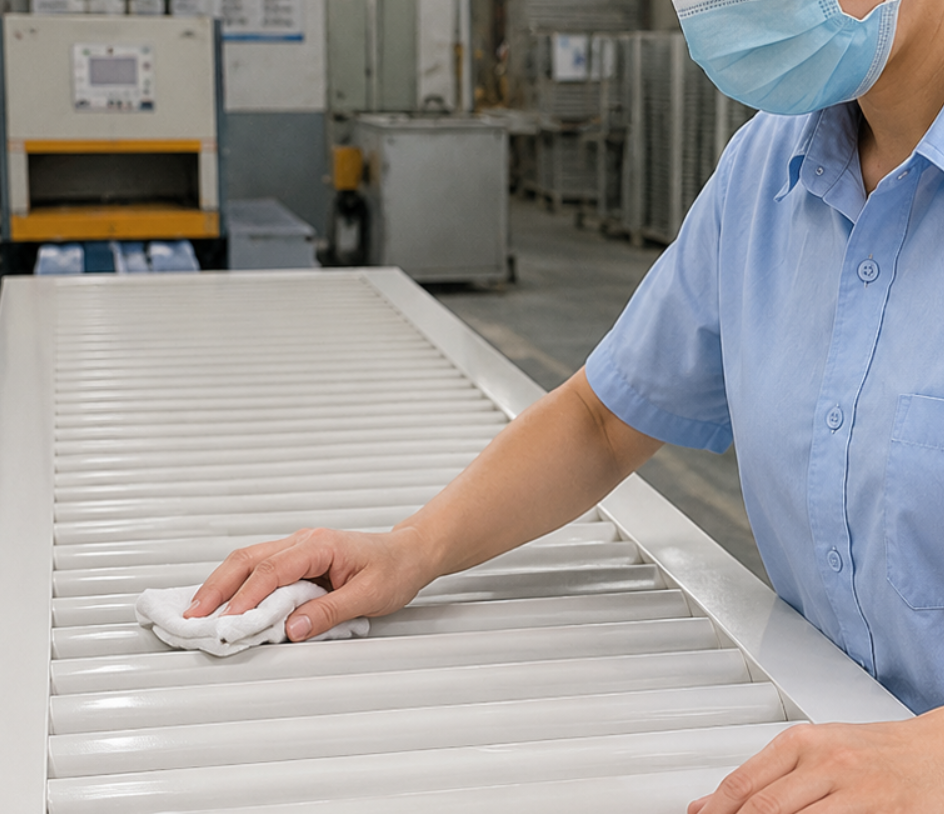
Processing of Shutters Material begins with raw stock preparation. Aluminum is extruded through precision dies to create consistent slat profiles, then cut to length and punched for assembly hardware. Steel sheet or coil is roll-formed or pressed into the required shapes, with edges treated to reduce sharp contacts.
Surface treatments such as anodizing, powder coating, or galvanizing are applied under controlled conditions to improve durability and appearance. Assembly lines join individual slats or panels with hinges, rivets, or interlocking edges so the finished curtain moves freely. Dimensional checks at each stage keep profiles uniform across production batches.
Effective Shutters Material must resist bending under wind load and impact while remaining light enough for the motor or spring system to operate. Interlocking designs prevent light and unwanted entry when the shutter is closed. Surface hardness affects how the material handles repeated contact with guides and end locks.
Thermal expansion characteristics influence how the curtain behaves across temperature changes common in industrial buildings. The material also needs to accept standard fasteners and end fittings without cracking or deformation. These functional traits arise directly from alloy selection, profile geometry, and finishing processes.
Warehouses and distribution centers use Shutters Material in high-cycle roller shutters that open and close multiple times per shift. Manufacturing plants install them at loading docks and internal partitions where rapid access and basic security are required. Retail and commercial buildings apply the same materials for storefront protection and service entrances.
Larger sectional or folding systems rely on robust Shutters Material to span wide openings without excessive deflection. In each setting the material must integrate with guides, barrels, and operators already specified for the project. Matching material properties to opening size and usage frequency supports smooth daily operation.
Buyers evaluate opening width, height, wind exposure, and expected cycle frequency when selecting Shutters Material. Weight limits of the existing or planned operator system further narrow the options. Security level and aesthetic requirements also influence whether aluminum, steel, or a composite solution is more suitable.
Clear communication of these factors allows the supplier to recommend profile designs and finishes that fit the actual duty. Matching material properties to the project early reduces later adjustments during installation and commissioning.
Recommended Products
Let's Start The Project Together!
Contact Information
No.6 Jianlan Road, Lanxi Economic Zone, Lanxi City, Zhejiang Province, China
+86-15958416076
+86-0579-88293800
+86-0579-88893800
Mobile




 Deutsch
 عربى