2026-11-06
Window coverings have a direct influence on how a room looks and functions. Beyond curtains and roller blinds, shutters have become a recognizable option in residential, commercial and hospitality projects. Their adjustable louvres, defined frames and different installation styles allow them to work as both functional window coverings and architectural details.
For manufacturers, distributors and building material suppliers, Shutters Window products represent a category with several design and production variations. Material selection, louvre structure, opening mechanisms and surface finishes all contribute to the final product. Understanding these differences helps explain why shutter designs vary across different building projects.
Louvre dimensions are an important design feature in Shutters Window products. Although the basic structure may look similar, small changes in louvre width, spacing and angle can create noticeably different visual effects.
Wider louvres provide a broader view when opened and create a cleaner appearance across the window. Narrower louvres produce a more traditional style, often associated with classic interior designs.
Manufacturers may offer several louvre configurations:
| Louvre Design | Visual Characteristics |
| Narrow louvres | Traditional appearance with more visible horizontal lines |
| Medium louvres | Balanced proportions for different interior styles |
| Wide louvres | Broader openings and a contemporary appearance |
| Fixed louvres | Consistent appearance without adjustable angles |
Color also plays a role in product presentation. White and neutral shades are commonly used in residential interiors, while darker finishes can create stronger visual contrast. Wood-effect surfaces provide another option for projects that require a natural material appearance.
The application of shutters extends across several types of buildings. Their appearance and operating structure make them suitable for different architectural settings.
Residential Buildings
Interior shutters are used in bedrooms, living rooms, kitchens and other residential spaces. Their adjustable louvres allow occupants to change the amount of incoming daylight while maintaining a consistent window appearance.
Hotels and Hospitality Projects
Hotels often use coordinated window coverings across guest rooms and shared spaces. Shutters can contribute to a unified interior design, particularly when their colors and finishes match the furniture and wall treatments.
Offices and Commercial Buildings
In office interiors, shutters provide an alternative to conventional blinds. Their structured appearance can complement contemporary office layouts and meeting spaces.
Exterior Architectural Applications
Exterior shutters are used on selected building facades as decorative or functional architectural elements. Their material and construction differ from interior models because they form part of the building's external appearance.
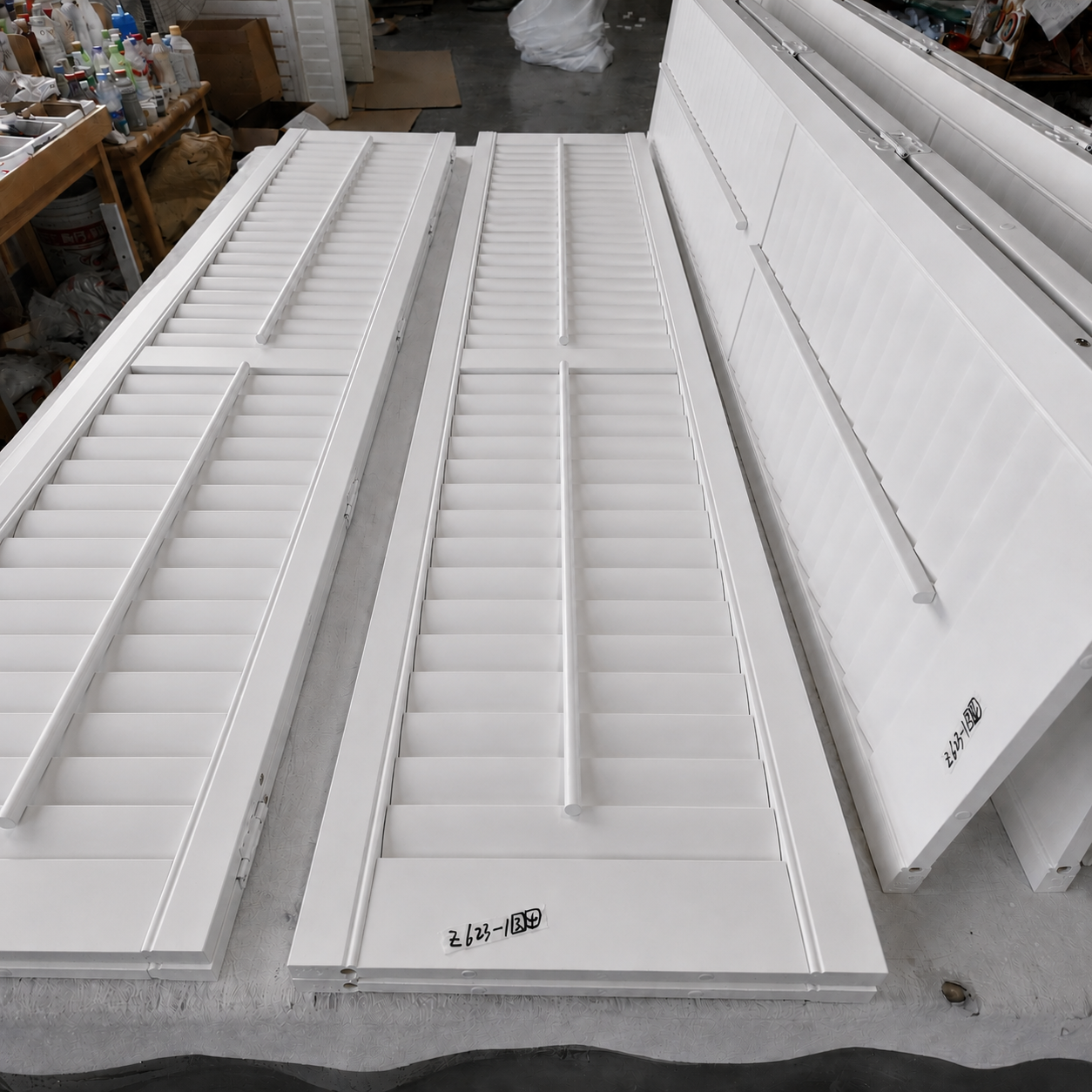
For distributors, project contractors and private-label brands, product customization is an important part of shutter manufacturing. Different markets and building styles may require variations in dimensions, colors, louvre widths and opening configurations.
Manufacturers can develop Shutters Window products around specific project requirements, including:
OEM and ODM services also allow brands to develop product collections under their own specifications. A manufacturer may produce several shutter styles using related frame designs while changing the materials, colors or panel arrangements.
As window coverings continue to serve both functional and decorative purposes in building projects, Shutters Window products offer manufacturers a broad range of design possibilities. Their combination of louvre geometry, material selection and panel construction makes them a distinct product category within the architectural window covering industry.
Recommended Products
Let's Start The Project Together!
Contact Information
No.6 Jianlan Road, Lanxi Economic Zone, Lanxi City, Zhejiang Province, China
+86-15958416076
+86-0579-88293800
+86-0579-88893800
Mobile




 Deutsch
 عربى